A crane scale weighs suspended loads: coils, big bags, ladles, containers or material under a forklift or crane. You will not notice a deviation from the indication, but you will from incorrect stock levels, overloaded lifting equipment or disputes about delivered quantities. MASSLAB calibrates crane scales with calibrated weights and our own lifting and transport equipment.
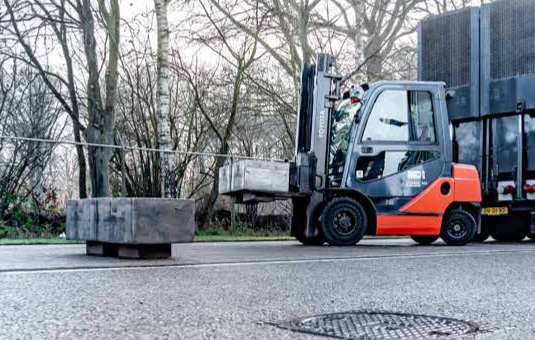
We calibrate all brands, including crane scales not purchased from us.
A crane scale has no platform. The eccentricity test is therefore usually omitted, but the repeatability and indication error are all the more important. We calibrate according to the principles of EURAMET cg-18:
We check the hook, the safety latch, the eye, the housing and the battery. We do not calibrate a crane scale with a damaged lifting component, because safety comes first.
The crane scale hangs freely, without load, and is given time to warm up and stabilise.
Using calibrated weights, we load the crane scale in steps up to or close to the maximum weighing range, and back down again. This shows us the indication error and any hysteresis.
A load is suspended and removed several times. The spread shows how reliably the crane scale weighs a load time after time.
You receive a certificate with the measurement results, the measurement uncertainty, the weights used and their traceability.
Calibrating a crane scale of several tonnes means suspending and removing heavy loads. We work with our own inspected weights of up to 2,000 kg per piece and with suitable lifting equipment. We carry out the test in a cordoned-off work area, with clear arrangements with your crane or forklift operator.
Please note: a calibration of the crane scale is not a load test of the crane or the lifting equipment itself. Do you need to test a crane or lifting installation? For such proof loads you can hire calibrated weights from us, including transport and placement.
Crane scales that are heavier than can practically be loaded with suspended weights are calibrated on our hydraulic tensile test bench at our force laboratory in Elspeet, up to approximately 51 t (500 kN). The crane scale is mounted between two tension fixtures and loaded in steps, while a calibrated reference force transducer measures the actual force. We convert that force to the kg or tonne indication of your crane scale using the local gravitational acceleration. Read more about this method under force calibration in tension and compression.
Select the range of your crane scale and add the calibration to your quote basket. To request a calibration with weights, please use the contact form.
Price on request · state make, type and requirements (display, number of steps, class) in the remarks of your request.
Most crane scales are used for internal checks, in which case a calibration certificate is sufficient for your quality system. If the weighed weight is used for invoicing, for example when buying or selling scrap or materials, the crane scale must be legally verified. After a repair to the weighing mechanism, a re-verification is then required. Read more under scale verification and re-verification.
Annually is customary. Crane scales that are used intensively, subjected to shock loads or hung in harsh environments should be checked more often.
Our own weights go up to 2,000 kg per piece and can be combined. Let us know the weighing range of your crane scale; we then match the test load and equipment accordingly.
No. During a calibration we measure how accurately the crane scale weighs. An inspection or load test of the crane or the lifting equipment is a separate assessment.
Yes, smaller crane and hanging scales can be delivered to us or collected by us. Large crane scales are usually calibrated on site.
New calibration weights, optionally with a certificate from our own laboratory.
Request a quote or call us. We calibrate in our own laboratory in Geldermalsen or on site, throughout the Netherlands and Belgium.