M-class weights are used to check the scales in production, warehouse and shop: bench scales, floor scales, pallet scales and weighbridges. We calibrate knob weights, block weights and ECO weights in classes M1, M2 and M3. Where necessary we also clean, repaint and adjust them, all in-house.
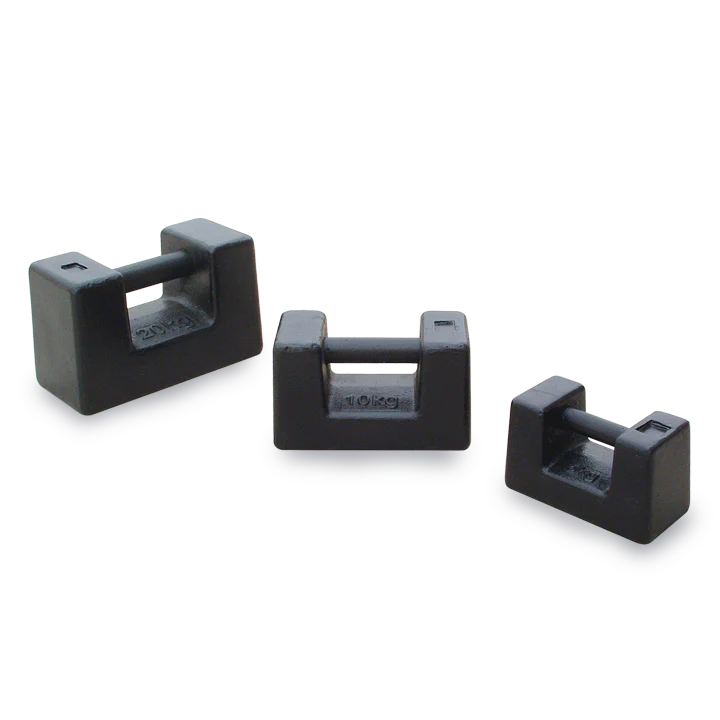
M-class weights come in many shapes and materials. We calibrate regardless of brand:
Stainless steel or chrome-plated knob weights from 1 g to 20 kg, usually with an adjustment cavity under the knob.
Rectangular cast iron or stainless steel weights from 5 kg to 50 kg and larger, with a grip or lifting eye and a sealed adjustment cavity.
Stackable block weights with a compact shape. They are practical for testing floor and pallet scales.
Mass pieces and block weights from 50 kg to 2,000 kg are calibrated using our own lifting and transport equipment.
Read moreThe M classes have wider tolerances than the F classes, but here too every gram counts. A 20 kg block weight in class M1 may deviate by no more than 1 gram.
| Nominal value | F2 | M1 | M2 | M3 |
|---|---|---|---|---|
| 1 g | 0.30 mg | 1.0 mg | 3.0 mg | 10 mg |
| 100 g | 1.6 mg | 5 mg | 16 mg | 50 mg |
| 1 kg | 16 mg | 50 mg | 160 mg | 500 mg |
| 5 kg | 80 mg | 250 mg | 800 mg | 2.5 g |
| 10 kg | 160 mg | 500 mg | 1.6 g | 5 g |
| 20 kg | 300 mg | 1 g | 3 g | 10 g |
| 50 kg | 800 mg | 2.5 g | 8 g | 25 g |
| 100 kg | 1.6 g | 5 g | 16 g | 50 g |
| 500 kg | 8 g | 25 g | 80 g | 250 g |
| 1,000 kg | 16 g | 50 g | 160 g | 500 g |
Maximum permissible error (±) according to OIML R111-1.
The weight must be more accurate than the scale you test with it. The common rule from OIML R76 is that the error of the test weight is at most one third of the error the scale is permitted at that load. In practice this means:
If in doubt, choose the finer class. You can also use an M1 weight later if you purchase a more accurate scale. For the calibration of scales according to EURAMET cg-18, the measurement uncertainty of the weight also determines the final result. Read more under scale calibration.
With us, a calibration of M-class weights is a complete overhaul of the test weight: inspection, cleaning, derusting and repainting where necessary, adjustment and recalibration. This way a cast iron weight lasts for years to come.
In practice, M-class weights are used heavily: they stand on floors, are moved with forklifts and come into contact with dust, moisture and oil. At intake we therefore first assess the condition of each weight.
Because all these steps take place in our own laboratory and our own workshop, weights do not have to go back and forth between different parties. That saves time and prevents damage in transit.
We compare M-class weights with reference weights of a higher class, using the OIML R111 weighing schemes. Our own LIMS software records every measurement, corrects for air density and calculates the conventional mass with its measurement uncertainty.
For each weight, the certificate states the measured value, the deviation, the measurement uncertainty and the assessment in its class. If a weight was adjusted, the values before and after adjustment are stated. The certificate is also available in your customer portal, together with the date of the next calibration.
Usually yes. We remove loose rust, treat the weight and apply a new protective coat. We then adjust and calibrate it. If the weight is so badly affected that it no longer remains stable, we advise replacement.
That depends on the deviation and the condition of the weight. We let you know in advance if adjustment is necessary, so there are no surprises. Please contact us for a quote.
For most floor and pallet scales in class III, M1 is the right choice. For coarse scales or class IIII, M2 is sufficient.
A weight can only be assessed in a class if it also meets the requirements for material, surface and shape of that class. A cast iron M1 weight therefore does not become an F2 weight, even if its deviation is small.
Yes. We collect weights with our own transport and equipment, even pallets full of block weights, throughout the Netherlands and Belgium.
New calibration weights, optionally with a certificate from our own laboratory.
Request a quote or call us. We calibrate in our own laboratory in Geldermalsen or on site, throughout the Netherlands and Belgium.