Large weights are used for weighbridges, floor scales, crane scales and proof load tests. Calibrating them takes more than an accurate measurement: they must be collected, moved, cleaned and returned safely. MASSLAB calibrates mass pieces up to 2,000 kg and arranges transport with its own equipment.
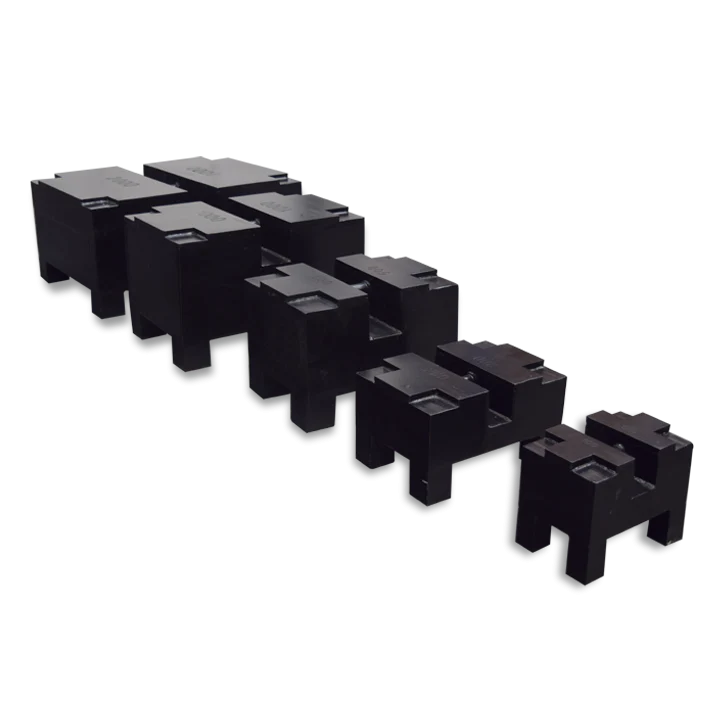
Do you have a non-standard design, such as a home-made test weight or a counterweight? Please contact us. We will assess whether a calibration according to R111 is possible, or whether a mass determination with certificate is the better option.
Heavy weights are usually used in an M class. For comparison, the maximum permissible error per class:
| Nominal value | F1 | F2 | M1 | M2 | M3 |
|---|---|---|---|---|---|
| 50 kg | 250 mg | 800 mg | 2.5 g | 8 g | 25 g |
| 100 kg | 500 mg | 1.6 g | 5 g | 16 g | 50 g |
| 200 kg | 1 g | 3 g | 10 g | 30 g | 100 g |
| 500 kg | 2.5 g | 8 g | 25 g | 80 g | 250 g |
| 1,000 kg | 5 g | 16 g | 50 g | 160 g | 500 g |
| 2,000 kg | 10 g | 30 g | 100 g | 300 g | 1 kg |
Maximum permissible error (±) according to OIML R111-1.
With heavy weights, most of the work is often in the logistics. We take care of it entirely ourselves:
You tell us which weights are involved: quantity, nominal value, design and how they can be accessed at your site. This allows us to plan the right transport and equipment.
We load the weights ourselves, with our own transport and lifting or forklift equipment. You need not prepare anything other than an accessible location.
In our laboratory we remove dirt, oil and loose rust. The weights then stabilise in temperature.
We determine the conventional mass by comparison with reference weights. If a weight falls outside tolerance, we adjust it via the adjustment cavity and measure again.
We bring the weights back and place them in the agreed location. By then the certificate is already in your customer portal.
A 1,000 kg mass piece in class M1 may deviate by no more than 50 grams. That sounds generous, but heavy weights have a hard life. They are moved with forks and chains, stand outdoors or in damp halls and get knocked against floors and loading beds. Flaking paint, rust, caked-on dirt and damage all change the mass.
If such a weight is used to test a weighbridge or crane scale, every deviation carries through into that test. A deviating test weight can cause a good scale to fail, or a deviating scale to pass. An up-to-date certificate prevents this.
Do you need heavy weights only a few times a year, for example for a crane test or a weighbridge check? Then hiring weights is often more economical than buying, storing and periodically calibrating them. Our rental weights are calibrated before delivery and supplied complete with certificate, transport and placement.
Would you like your scale and your own weights calibrated in a single round? We are happy to combine the two. We calibrate your weighbridge or crane scale with calibrated weights and take your own mass pieces back to the laboratory.
We calibrate weights up to 2,000 kg each. Heavy weights are usually calibrated in classes M1, M2 or M3. If you have a heavy weight in an F class, please consult us beforehand.
No. We collect them and bring them back with our own transport and equipment, and load and unload them ourselves, throughout the Netherlands and Belgium.
For an accurate calibration according to R111 we prefer to work in our laboratory. Please contact us if moving the weights is not possible; we will then discuss the options.
We then assess whether the cavity can be opened safely. If this is not possible, we calibrate the weight with its measured value or advise on replacement.
Yes. Mass pieces and block weights can be bought in our webshop, and for temporary projects you can hire calibrated weights.
New calibration weights, optionally with a certificate from our own laboratory.
Request a quote or call us. We calibrate in our own laboratory in Geldermalsen or on site, throughout the Netherlands and Belgium.