Laboratory balances

Analytical balance and precision balance calibration

In a laboratory, everything revolves around small quantities. A deviation of a tenth of a milligram can make an analysis, formulation or batch release unreliable. MASSLAB calibrates analytical balances, semi-micro balances and precision balances on site at your premises, using weights of the appropriate class from our own laboratory.
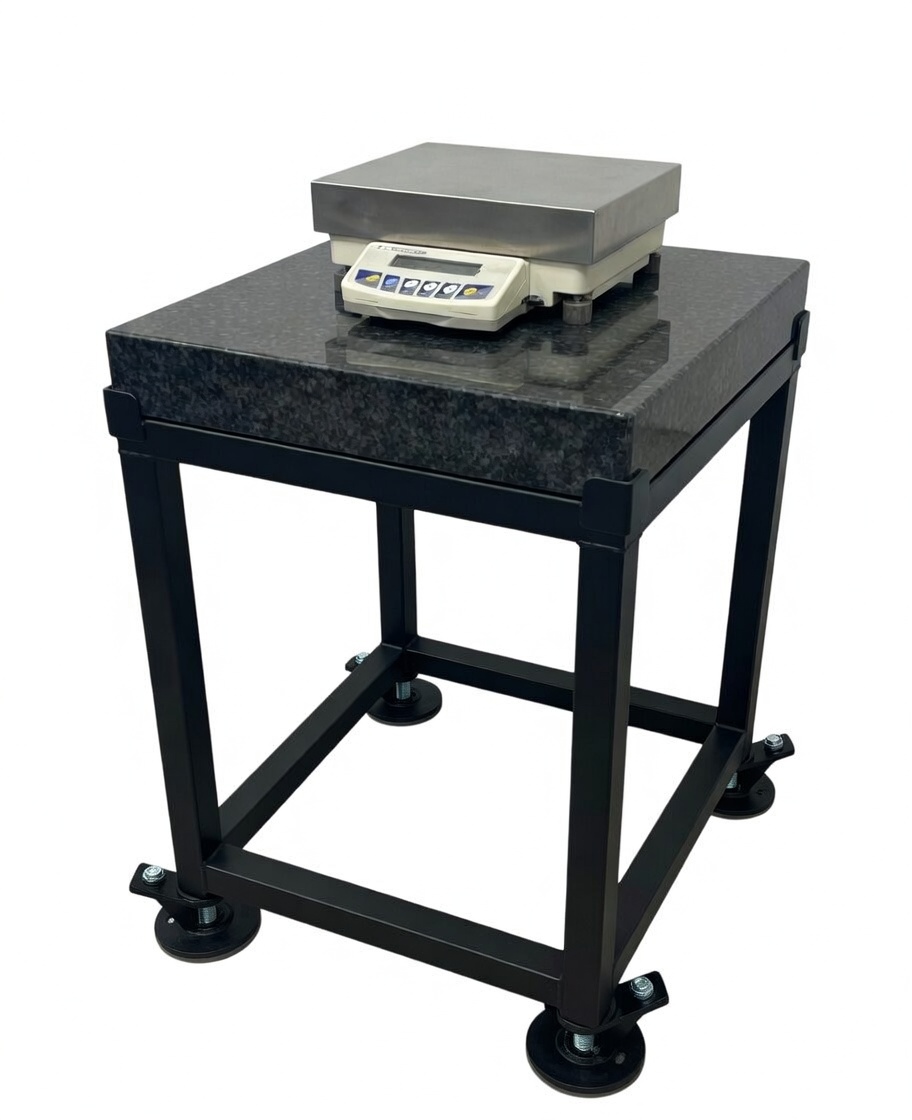
Precision balance on an anti-vibration calibration table

Which balances do we calibrate?

  • Analytical balances with a readability of 0.1 mg;
  • Semi-micro balances with a readability of 0.01 mg;
  • Precision balances with a readability of 1 mg to 1 g;
  • Moisture analysers and laboratory scales with a weighing function;
  • balances in fume cupboards, isolators and weighing enclosures, where air flow requires extra attention.

We calibrate independently of brand, so also balances from brands we do not supply ourselves.

Weights of the appropriate class

The more accurate the balance, the more accurate the weights need to be. The measurement uncertainty of the test weight contributes directly to the result of the calibration. For an analytical balance with 0.1 mg readability we therefore use weights of class E2 or better. For precision balances these are usually F1 or F2 weights, depending on the readability and the weighing range.

We manage our reference weights ourselves and know the current value and uncertainty of every weight. Your certificate lists the weights used, with their traceability to national standards.

What does a laboratory calibration focus on?

With fine balances, the environment is as decisive as the balance itself. Our technicians therefore pay attention to:

  • Acclimatisation: the weights are given time to take on the temperature of the room. A warm weight causes air flow in the weighing chamber and gives a deviating indication.
  • Warm-up time and levelling: the balance must be warmed up according to the manufacturer's instructions and be precisely level.
  • Draughts, vibration and static charge: doors, air conditioning, extraction and vibrating equipment affect the measurement. We record these and, where necessary, discuss improvements, such as an anti-vibration weighing table.
  • Internal adjustment: many balances have an internal adjustment weight. We check that it works properly and measure the balance as it is used in practice.

Minimum weight and measurement uncertainty in use

A balance with a readability of 0.1 mg is not suitable for weighing out 0.1 mg accurately. With small quantities the relative error increases, mainly because of the repeatability. The minimum weight is the smallest quantity at which the measurement uncertainty remains within your own requirement, for example 0.1 % or 1 %.

From the calibration measurements, the measurement uncertainty in use can be calculated, and from that the minimum weight for your requirement. Do you work according to pharmaceutical regulations or internal procedures with your own tolerance? Let us know in advance. We then tailor the measuring points and the reporting accordingly.

Interim checks in your laboratory

A calibration is a snapshot. Many laboratories therefore check their balances daily or weekly themselves with a check weight and record the result. This way you spot a deviation in time and can show the auditor that the balance was also in order between two calibrations.

For these checks you use weights with a valid certificate. We supply E2 and F1 weights and calibrate your own check weights of class F1 and lower in our laboratory. If you hand them over during the calibration visit, we take care of both at once.

Frequently asked questions

How often should an analytical balance be calibrated?

Usually annually, supplemented by your own daily or weekly check with a check weight. For critical applications or heavy use, laboratories often opt for a shorter interval.

Does the balance have to be sent to your laboratory for this?

No. We prefer to calibrate laboratory balances in their own location, because the environment contributes to the result. Our technician comes to you with the weights.

What is the minimum weight of my balance?

That depends on the repeatability at your location and your own accuracy requirement. The minimum weight can be determined from the calibration measurements; let us know your requirement in advance.

Is the internal adjustment of my balance not sufficient?

No. The internal adjustment weight allows the balance to correct itself, but it is not a traceable calibration. A calibration with external certified weights shows whether the balance really weighs correctly.

Can you also calibrate balances in a fume cupboard?

Yes. We calibrate the balance under the conditions in which it is used and state the environment on the certificate.

Buy weights

New calibration weights, optionally with a certificate from our own laboratory.

Related services

From the knowledge centre

All articles →

Schedule a calibration or verification?

Request a quote or call us. We calibrate in our own laboratory in Geldermalsen or on site, throughout the Netherlands and Belgium.

View basket →